Famous characters who went down in history thank to their psychic power
Middle age, Europe, France
Joan of Arc (1412-1431), named the maid of Orleans was french female peasant aged of 13 started to hear voices and have visions from saints, She started first to hear voices then had visions from according to her from Saint Michaeal the archangel, Saint Margaret of Antioch and Saint Catherine of Alexandria. Her supernatural experience was accompanied by a flash of light.

At the very beginning people from her village in Domremy were skeptical about her manifestations, and ecclesiastical authority was puzzled and wary.
At the beginning her visions told her to attend church, be good and stay virgin, later on her mission on earth was more precise. She was told by the saints to take the siege of Orleans by leading an army, help the crown prince for his coronation in Reims to become a legitimate king, and free France from the English.Joan affirmed that the voices and visions from the saint felt holy bringing her comfort and tears of joy.
At that time France was invaded by England, french army was at loss, despite her age, her gender and her social status, more and more people heard about Joan ‘s story, even the crown prince of France Charles VII and saw and sized the opportunity to boost moral of the french army by giving them the innocent virgin teenager with holy visions. Charles VII received Joan of Arc winter 1429 in his castle in Chinon in disguise to test her, she immediately identified him as the future king and assured him his legitimacy that convinced Charles that she truly had a divine mission. Charles sent her to Poitiers to be tested by theologians to make sure she was a catholic believer.After these tests Charles VII gave her an armor, a horse and an army.
At the age of 17 years old she was leading the french army not as a general but more like “mascot” or ray of hope for the French soldiers who had a very low morale before she took the lead. With her help the French army took the siege of Orleans in only 9 days after 7 long months of English siege. This feast was a great turning point of the 100 years war between France and England on May 8th 1429. She showed great courage despite being injured with an arrow despite not having a military background but a peasant background. This event substantiated even more the fact that she has holy guidance through her visions.
After the siege of Orleans, Joan could secure the throne for Charles VII as she predicted it beforehand with his coronation in the church of Reims the july 17th 1429.
After Charles VII coronation, Joan's reputation started to wane, she tried to retake Paris in late 1429 but failed she even got injured and the king started to distance himself from her.
May 1430 Joan got captured by Burgundians who were English allies , they sold her to English for 10000 pounds. From this moment she became a war prisoner who had a trial before the court of the catholic church accused of heresy, witchcraft and cross dressing, Her trial started in January 1431 to May 1431. It was a political strategic maneuver to discredit Joan of Arc and send her to death.
The Judge and prosecutor, Bishop Pierre Caushon was a supporter of the english burgundian alliance.The trial was meant to prove that the voices Joan heard come from the devil.After 4 months intense questioning Joan of arc stayed firm on her answers.
Her answered were smart despite she did not have a lawyer to represent her. Despite the biased trial and knowing the inevitable Joan did not budge about her statements.She was executed by burning at a stake at the market of Rouen on May 30th 1431. The crowd who assisted in this execution were divided about her fate.
University of Paris provided assessors for Joan trial,execution at this time Paris was under control of the bungundia english alliance and the place of condemnation Rouen was held by the English till 1436.
1455 Joan’s mother, Isabelle Romée appealed for justice to the new Pope Calixtus III, who granted her an investigation on Joan’s case. The new judges on this case asked joan trial file, and they found out there was no eye witness in favor of accusations, that Joan ‘s friends were questioned and all of them testify she had a good morality and was an exemplary christian. The main witness Jean Dunois, a knight who fought with Joan against the English, testified she had divine powers. After a very long investigation it was concluded that Joan was innocent and the rehabilitation trial was proclaimed on July 7th 1456.
April 18th 1909 Joan of Arc was beatified in St Peter basilica, Rome, Italy by Pope Pius X. She was declared blessed and recognized for her virtue.
On May 16th 1920, Joan of Arc was canonized as a Saint by the Roman Catholic church by Pope Benedict XV.
When you look closely at the chronological journey of Joan of Arc, she was perceived like a liar or a lunatic, then acknowledged by being guided by a divine mission, then became a war leader, a hero, an outcast, a witch, a blessed one and a Saint.
Despite her long and challenging journey some mental specialists evoke she could suffer from epilepsy or schizophrenia.
In some cases, like Joan of Arc as we could observe through history, her status with her psychic power or spiritual gift, (clairaudience and clairvoyance) was dependent on political views and needs at that time. Crown prince Charles VII needed some external help to legitimize himself as a kind of France, help he found by giving Joan an army to kick out the british army and by doing so he could pretend that his reign was supported by the divine with Joan's holy guidance.
Then later in her life she was declared unholy and condemned to death as a witch by the church. Politics and religion can worship you or bring you death. It can give you the status of a hero, a witch or a saint.
18th century or Age of Enlightenment, Europe, Germany
Ludwig van Beethoven (1770-1827),born in Bonn Germany, into a musician family with an alcoholic court singer father named Johann who forced him at an early age, 4 years old, to learn music hoping to make his son a prodigy. His training was long,draconian and brutal, finishing often late at night even at an early age.
The typing Ludwig get beaten quite often when his practice was not long enough according to Johann, his father. Johann von Beethoven knew how to play violin and zither (similar to a guitar), he was the first teacher to Ludwig his son by teaching keyboard and violin.His father asked his musicians colleagues from the court to help teach music to his son.
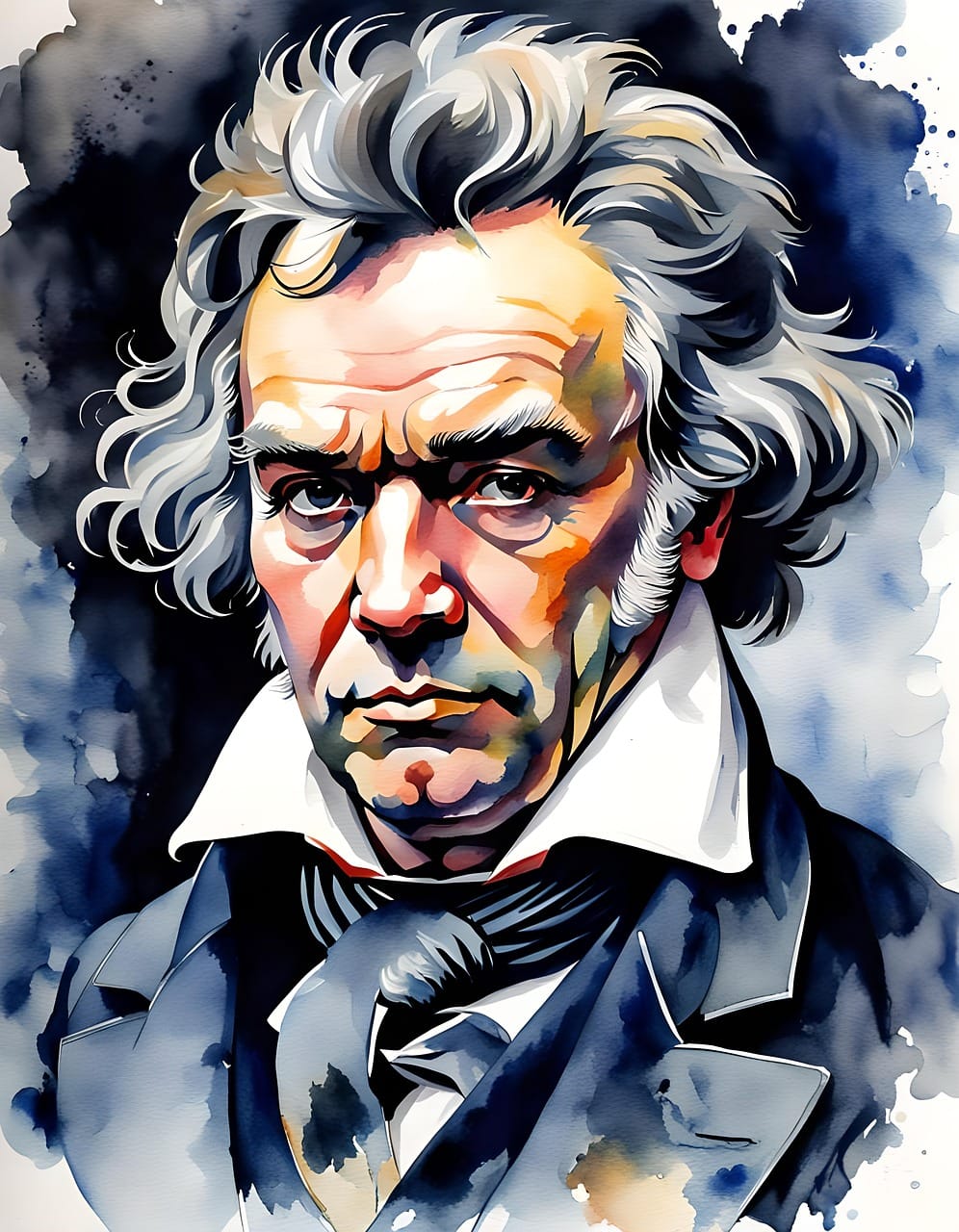
Around 10 years old Ludwig started composition lessons with Gottlob Neefe, he published his first work in 1783 and was noticed by a famous magazine at 11 yo only and was hired by the court chapel one year later.
In 1787, Ludwig van Beethoven went to Vienna to meet Wolfgang Amadeus Mozart, a very famous musician and composer in Germany and all Europe at that time. During his trip to Vienna he learned her mother passed away, shortened his travel to come back to Bonn (before Germany now Switzerland) to help his family.
After losing his wife, Johann, the father, started to drink even more so much that he lost his job as a singer at the court.Ludwig had to deal with mourning and financial setback situation, and had to provide money for his family by playing in an orchestra and by teaching music lessons the beethoven family could ends meet.
In 1790 was a turning point in Ludwig's life , he met the famous composer Franz Joseph Haydn in Bonn and became his student two years later by moving to Vienna. At 22 years old Ludwig really started to make a name as a composer in Germany and Europe.
Around his 28 years old he started to lose his audition little by little and hide his disability fearing to ruin his career.Against all odds he continued to compose and perform.
In 1802, he is 32 years old and in a suicidal state because of the lost of his audition (Heiligenstadt Testament). From then he redefined his style of music and started to compose a famous music like the 3rd symphony Eroica in 1803,.He lost the totality of his audition at the age of 45 years old and composed his most famous composition the 9th symphony in 1824 despite being totally deaf. He kept composing because he could still hear music in his head, the gift is called “ the absolute pitch”.
His inner ears he used to compose after being deaf called the absolute pitch are in fac clairaudience.
By retracing his life with child abuse, a parent lost, finance issues, success,disability that could ruin his career, depression, spiritual gift, huge success. In Ludwig van Beethoven case because of his fame, his psychic power was acknowledged as a spiritual gift and not like a mental disorder.
19th century, Europe, France
Victor Hugo 1802-1885, romantic author, poet and politician, born in Besancon, France in a family very inclined to politics, his mother Sophie was a royalist and his father general in the Napoleon army. He graduated from the law university of Paris but his interests were toward literature.
He founded a review in 1819 Le Conservateur Litteraire where he published his articles and the same year he published his own book of poems which was influenced by loyalism and thanks to that he attracted the attention of the king Louis XVIII and could receive a pension. 2 years later he published his first novel Hans of Iceland which was also translated in english.
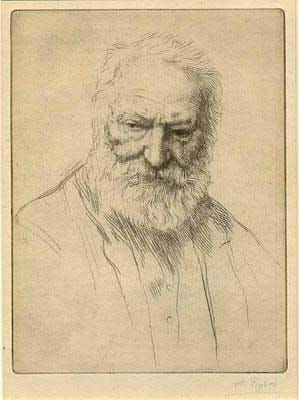
A journalist introduced Victor Hugo to a group of friends influenced by Romanticism that was a turning point in Victor Hugo's career. Because of this romanticism influence his work started to change from moderate to provocative highlighting the duality of being. From loyalist to liberalist.
1831 was the year of his fame with the novel The Hunchback of Notre Dame that condemned a society where two nobles led two innocent communers to an unjust death. A male with a big physical disability and a female belonging to an underrepresented minority.
His work started to have a paranormal context with a poems like “ The Two Voices” in 1831 or “Inner voices” in 1837 suggesting he could hear spiritual voices.
In 1843 his daughter Leopoldine died, Victor was devastated, from then, he wrote Les contemplations divided in 2 parts, yesterday and today, time marketed to grief her daughter's death.Her death was a trigger that reinforced his beliefs in paranormal and raised his psychic powers too.
After 1848 he was into politics himself and supported Prince Louis Napoleon who became a president in the second republic but unfortunately for Victor, this turned out to be a poor choice because this president became more and more authoritative and started a coup d'etat in 1851 where Prince Louis Napoleon became Napoleon 3 under the second empire. Victor was in the resistance, failed and fled to Brussels Belgium for Exile.
His exile from 1851 to 1870 marked a high productivity in satirical poems. Years 1852 to 1855 he traveled to Jersey Island where he met a spiritism group that deeply influenced his works.
Through Oui-Ja sessions he was communicating with Shakespeare,Voltaire. Because of his fame and deep reflection on society, politics and human behaviours, his mysticism through his clairaudience was for his time seen as spiritual and artistic.
19th century, India
Mahatma Gandhi 1869-1948, was an Indian lawyer, politician and social activist who could hear a voice which he called the inner voice or the voice of god that appeared to him after a huge struggle mostly in his dreams.
Gandhi described this voice as more real than his own existence and helped him taking important decisions in his political life.

Carl Gustav Jung 1875-1961, Swiss psychiatrist and psychotherapist could hear voices and had visions. He studied on a deeper level what he called hallucinations documented everything in The Red Book, organized his spiritual experiences and called it "active imagination".

Anthony Hopkins had a life struggle with alcohol and in 1975 the turning point appeared by hearing voices that guided him to quit drinking.
All these people have in common either a huge psychological trauma or disease that triggered their psychic powers or a supernatural encounter. and in many cases religions, beliefs and politics can adulate or denigrate you and your spiritual gift giving you a positive or negative picture of your psychic powers and yourself.
Written by Kim Lessage — clairvoyant, medium, and medium instructor since 2006. Kim has helped hundreds of students understand and develop their psychic gifts, from beginners to advanced practitioners.
She is the author of Shadow Becoming Light, available on Amazon.